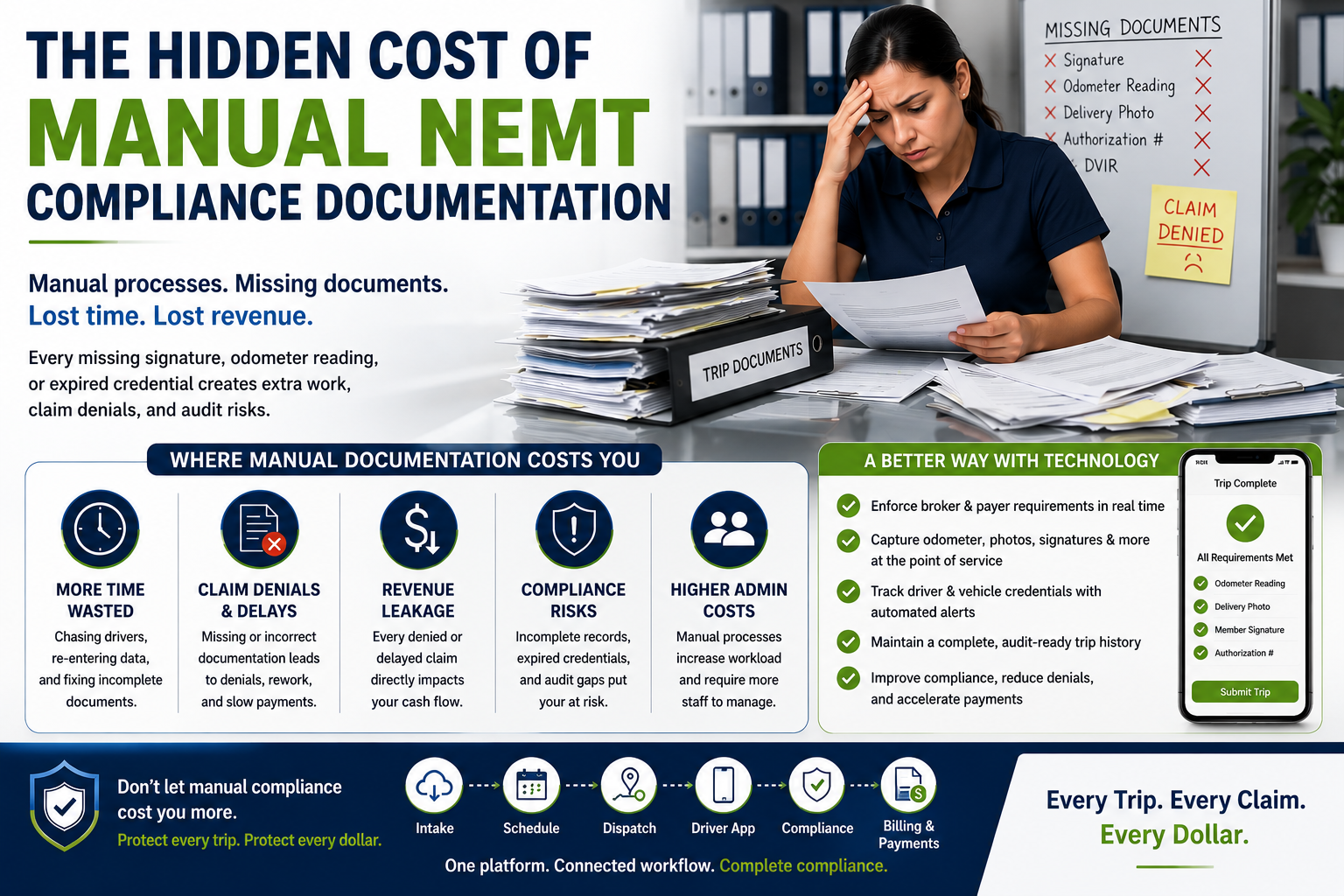
For an NEMT provider, compliance documentation is part of almost every trip.
A driver may need to record an odometer reading. A member may need to provide a signature. A broker may require a delivery photo. A vehicle may need a pre-trip inspection. A no-show may need to satisfy a required waiting period before it can be documented.
Individually, these tasks may seem small.
Across hundreds or thousands of trips, however, manually managing them can become a significant operational burden.
The real problem is not simply the amount of paperwork.
It is what happens when documentation is missing, incomplete, entered incorrectly, stored in different places, or discovered only after the trip has already been completed.
That can create additional work for dispatchers, drivers, compliance teams, and billing staff—and potentially create problems further down the revenue cycle.
This is why modern NEMT compliance is moving away from remembering requirements and toward building requirements directly into the workflow.
What Does NEMT Compliance Documentation Actually Include?
Compliance documentation in NEMT is not one single form.
It can involve information captured before, during, and after a trip.
Depending on the state, payer, broker, and trip requirements, documentation can include:
- Driver credentials and certifications
- Vehicle inspections
- DVIR records
- Odometer readings
- Member signatures
- Delivery photos
- Authorization information
- GPS and trip-location information
- No-show documentation
- Wait-time information
- Incident reports
- Emergency records
- Broker-specific trip requirements
Avenex is designed to manage these requirements through configurable state, payer, and broker rules. Its compliance framework includes driver and vehicle credentialing, HIPAA audit trails, state rules, and per-plan requirements such as odometers, photos, authorization numbers, and signatures.
The challenge for providers is making sure the right requirement is captured at the right time by the right person.
The Problem With Manual Compliance
Manual compliance often depends on people remembering what needs to happen.
A dispatcher may know that a particular broker requires a photo.
A driver may remember that another trip requires odometer readings.
A compliance manager may maintain a spreadsheet containing credential expiration dates.
A billing employee may discover that a required document is missing several days later.
This creates a fragile process.
The more brokers, states, payers, drivers, and vehicles a provider works with, the more difficult it becomes to manage every requirement consistently.
Avenex’s product documentation identifies this exact gap: NEMT rules can otherwise become buried in spreadsheets and tribal knowledge, while missing documentation such as an odometer reading or delivery photo can contribute to claim problems.
1. Manual Documentation Takes Time From Your Operations Team
Consider what happens when documentation is collected manually.
A driver completes a trip.
The dispatcher later checks whether the required information was captured.
Something is missing.
The dispatcher contacts the driver.
The driver searches for the information.
The billing team waits.
The trip cannot move forward cleanly until the issue is resolved.
Multiply that process across a large number of trips, and the administrative workload becomes substantial.
The problem isn’t necessarily that employees are doing their jobs poorly.
The problem is that the workflow requires too many manual checks.
A better approach is to make the system perform those checks while the trip is happening.
2. Missing Documentation Can Become a Revenue Problem
Compliance and revenue are closely connected in NEMT.
A trip can be operationally successful—the passenger was transported, the vehicle arrived, and the ride was completed—but still create a billing problem if required evidence is missing.
For example:
Trip completed → required documentation missing → claim readiness affected → manual investigation → delayed submission or correction
This is why documentation shouldn’t be treated as an administrative task that happens after transportation.
It should be treated as part of the trip itself.
Avenex’s workflow is designed around this principle: the driver application enforces broker-specific delivery requirements and produces an audit-ready completed trip before the billing process proceeds.
3. Different Brokers Can Require Different Documentation
One of the biggest challenges for NEMT providers is that requirements aren’t always identical across brokers.
For example, Avenex’s current broker configurations include:
MTM
MTM trips require odometer start and end readings at delivery, with the authorization number displayed to the driver.
ModivCare
ModivCare trips require a delivery photo before completion.
Southeastrans
Southeastrans trips require odometer start and end readings, with its roster integration supporting additional trip and mobility information.
This illustrates an important operational principle:
The driver shouldn’t have to memorize every broker’s compliance checklist.
The technology should know which requirements apply to the trip.
4. Spreadsheets Don’t Enforce Compliance
Spreadsheets can be useful for tracking information.
But they don’t stop a driver from completing a trip without the required documentation.
They don’t automatically prevent a trip from being marked complete.
They don’t necessarily know which broker requirement applies to a specific trip.
And they don’t provide a real-time workflow between the driver, dispatcher, compliance team, and billing team.
Avenex takes a different approach.
Its rules are configured by state, payer, and broker and can be applied directly to the web and mobile workflows.
For example, a plan can be configured to require:
- Odometer readings
- Delivery photos
- Authorization numbers
- Member signatures
These requirements can then become part of the trip-completion workflow rather than simply appearing on a checklist somewhere else.
5. The Driver Shouldn’t Have to Guess What Is Required
One of the most important principles in compliance technology is guidance at the point of action.
A driver should not have to call dispatch and ask:
“Do I need a photo for this trip?”
Or:
“Do I need the odometer reading?”
Or:
“What authorization number should I use?”
The required information should be visible within the trip workflow.
Avenex Driver+ displays trip information, broker-specific notes, payer information, and other requirements directly to the driver. At completion, the system checks the applicable requirements before allowing the trip to be submitted.
For MTM trips, for example, the driver sees the authorization number and must provide the required odometer readings before completion. Member signature capture is also enforced.
This changes compliance from a memory-based process into a workflow-based process.
6. Vehicle Compliance Is Part of the Same Challenge
Compliance doesn’t start when the passenger enters the vehicle.
Vehicle readiness matters too.
Avenex Driver+ includes a pre-trip DVIR workflow. Critical vehicle failures can prevent the vehicle from entering service until a coordinator clears the issue.
The platform also supports tracking of:
- Vehicle inspections
- Insurance
- Driver certifications
- Credential expiration dates
- Required documentation
Expired driver credentials can be flagged before assignment, while a failed DVIR with a critical defect can take a vehicle offline until it is cleared.
This is important because effective compliance isn’t just about storing records.
It is about preventing non-compliant activity from continuing.
7. No-Show Documentation Can Also Become a Compliance Issue
No-shows are another example of why timing matters.
A provider may need to document that the driver arrived, waited the required amount of time, and followed the appropriate process before recording the passenger as a no-show.
If this is handled manually, staff may need to reconstruct the event later.
Avenex applies state-specific no-show wait requirements and records supporting information such as wait time, driver location, and photo as part of the trip history.
This creates a stronger record of what actually happened.
8. Manual Compliance Creates a Bigger Problem During Audits
When documentation is scattered across:
- Paper forms
- Spreadsheets
- Driver phones
- Emails
- Separate applications
- Shared folders
finding the complete history of a trip can take significant time.
An auditor may not only want to know whether a trip occurred.
They may need to understand what happened throughout the trip lifecycle.
Avenex maintains an immutable trip history from booking through delivery, while its audit framework records create, update, and status changes with user ID, timestamp, and IP. Records are soft-deleted rather than hard-deleted so information remains available for audit, reporting, and recovery.
This provides a much stronger foundation for audit readiness than trying to reconstruct events from disconnected records.
9. Compliance Requirements Change
Another challenge is that NEMT compliance isn’t static.
State policies, payer requirements, and broker rules can change.
A provider that relies heavily on hard-coded processes or outdated spreadsheets can struggle to keep every team member aligned.
Avenex uses configurable rules for all 50 states and the District of Columbia, including areas such as:
- Advance booking requirements
- No-show waiting periods
- Geofence requirements
- Procedure-code defaults
- Authorization requirements
- Billing formats
The platform also supports configurable payer and broker requirements. Changes can take effect without requiring a software release.
This is particularly valuable for organizations operating across multiple states or working with multiple plans and brokers.
The Real Cost of Manual Compliance
The cost of manual documentation isn’t limited to paperwork.
It appears in several areas of the business.
Administrative Cost
Employees spend time checking, chasing, correcting, and organizing documentation.
Operational Cost
Dispatchers and coordinators spend time resolving issues that could have been prevented during the trip.
Billing Cost
Missing documentation can create additional claim-review and correction work.
Compliance Risk
Incomplete records make it harder to demonstrate that requirements were followed.
Audit Cost
Staff may need to spend hours reconstructing historical trip information.
Growth Cost
As trip volume increases, manual compliance processes become harder to scale without adding more administrative resources.
The biggest issue is that these costs are often distributed across different departments.
No single error looks enormous.
But collectively, they create operational friction throughout the organization.
What a Better NEMT Compliance Workflow Looks Like
A modern compliance workflow should follow the trip rather than exist separately from it.
Before the Trip
The system should verify:
- Driver credentials
- Vehicle readiness
- Applicable state rules
- Payer requirements
- Broker requirements
- Authorization information
During the Trip
The platform should capture:
- GPS information
- Trip status
- Wait time
- Required driver actions
- Incident information
At Delivery
The system should enforce:
- Odometer readings when required
- Delivery photos when required
- Member signature
- Authorization information
- Other broker-specific evidence
After Delivery
The system should provide:
- Complete trip history
- Audit-ready documentation
- Claim-readiness checks
- Billing information
- EDI 837P generation
Avenex connects these stages rather than treating compliance as a separate administrative function. Its platform connects broker intake, scheduling, dispatch, Driver+, billing, and rules and compliance within the same trip lifecycle.
How Avenex Reduces the Burden of Manual Compliance Documentation
Avenex’s approach is simple:
Don’t ask employees to remember every rule. Build the rules into the workflow.
The platform combines:
Broker-Specific Rules
Requirements can be configured per broker and payer plan.
Driver+ Enforcement
Required documentation is captured within the driver workflow and cannot simply be skipped.
Credential Management
Driver certifications and vehicle requirements can be tracked with expiration dates and document uploads.
State Rules
State-specific requirements can be configured and updated from the admin interface.
Audit Trails
Trip and system activity is retained with detailed history.
Connected Billing
Completed trips can move into EDI 837P claim generation using billing information captured earlier in the workflow.
This creates a connected chain:
Rules → Trip → Driver → Documentation → Delivery → Claim
Instead of:
Trip → Paperwork → Spreadsheet → Manual Review → Missing Information → Billing Follow-Up
Compliance Should Prevent Problems—Not Just Document Them
This is perhaps the most important shift for NEMT providers.
Traditional compliance processes often focus on documenting what happened.
Modern compliance technology can go one step further:
It can help prevent the problem from happening in the first place.
If an odometer reading is required, don’t discover it is missing tomorrow.
Require it before the driver can complete the trip.
If a delivery photo is required, don’t wait until billing discovers it is missing.
Make it part of trip completion.
If a credential is expired, don’t discover it after assignment.
Flag it before the driver is assigned.
If a state has a specific no-show waiting period, don’t rely on memory.
Build the requirement into the workflow.
That is the difference between recording compliance and operationalizing compliance.
How Avenex Helps
Avenex brings broker integration, scheduling, dispatch, driver workflows, compliance, and billing together in one NEMT platform.
Its compliance capabilities are designed to make broker and payer requirements actionable within the trip workflow—not something drivers and coordinators have to remember manually.
From driver credentials to trip documentation to claim readiness, Avenex helps providers close the compliance gaps that can cost time, create rework, and put revenue at risk.