
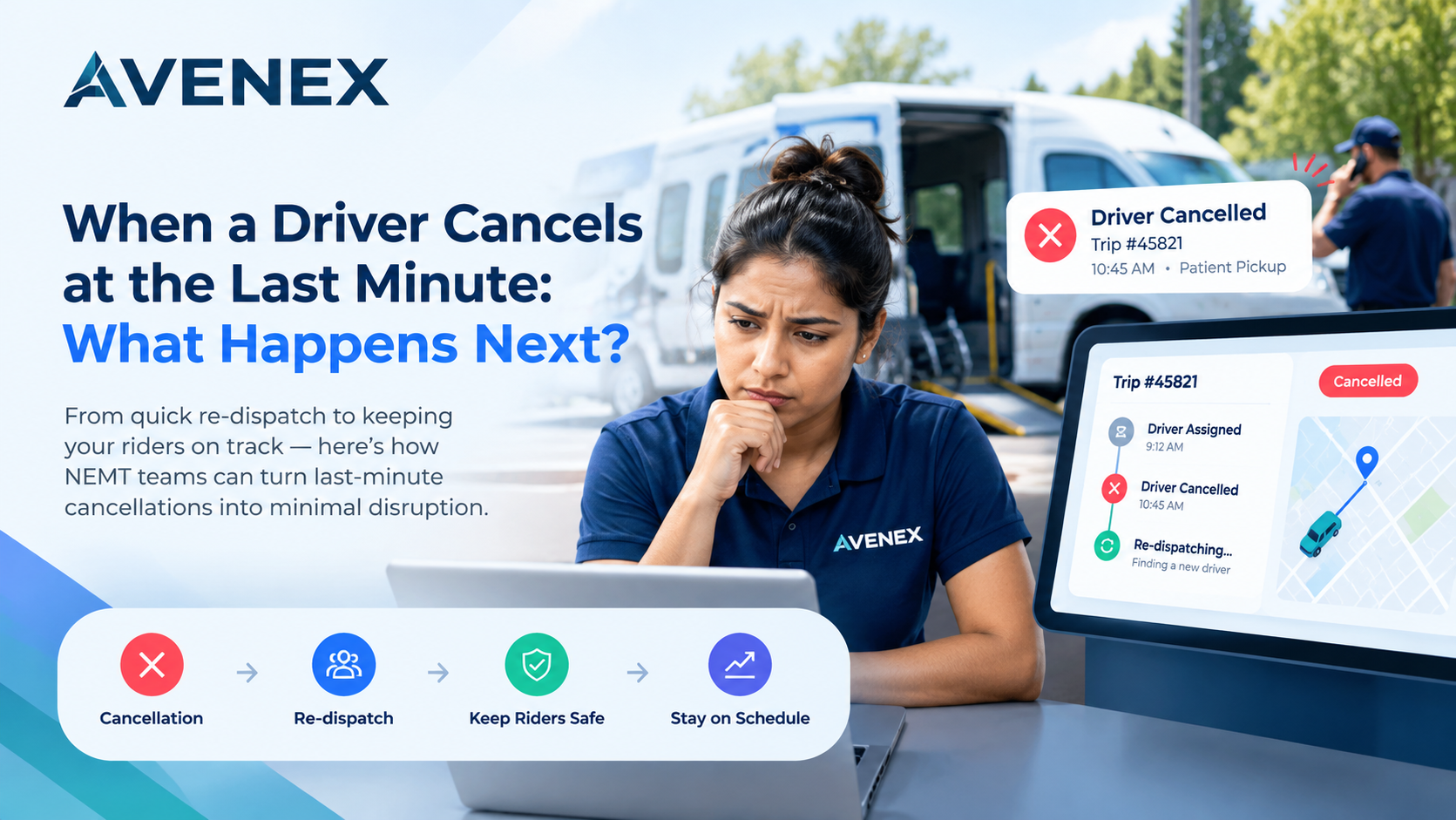
It is 7:42 AM.
A driver is scheduled to pick up a Medicaid member at 8:00 AM for a medical appointment.
Then the message arrives:
“I can’t make the trip.”
The dispatcher now has a problem.
There are only 18 minutes until pickup.
The member still needs transportation.
The broker still expects the trip to be covered.
The replacement driver needs to be qualified and available.
And the rest of the day’s schedule cannot simply stop while the dispatcher solves one problem.
This is one of the most stressful situations in NEMT operations.
A last-minute driver cancellation isn’t just a staffing issue. It can quickly become a dispatch, service, compliance, broker, and revenue problem.
For NEMT providers, the real question isn’t:
“What do we do when a driver cancels?”
It is:
“How quickly can the operation detect the cancellation, find an appropriate replacement, communicate the change, and preserve the trip?”
That requires a process—not a last-minute phone call.
Why a Driver Cancellation Is More Serious in NEMT
In ordinary transportation, a canceled driver may simply mean the next available vehicle takes the ride.
NEMT is different.
The trip may involve:
- A Medicaid member
- A medical appointment
- A specific pickup window
- A particular mobility requirement
- A broker authorization
- A qualified driver
- A suitable vehicle
- Required documentation
- A return trip
- Broker-specific operational rules
Medicaid programs are required to assure necessary transportation for eligible beneficiaries, but states can use different delivery and administrative models. Many programs involve brokers or managed-care arrangements, meaning the operational process can vary by state and contract. (Medicaid)
So when a driver cancels, the provider isn’t simply replacing a person.
The provider is trying to preserve an entire transportation workflow.
The First 5 Minutes Matter
Consider this scenario.
8:00 AM pickup
Driver cancels at:
7:42 AM
If dispatch discovers the cancellation immediately, there may still be time to:
- Identify available drivers
- Check driver credentials
- Check vehicle suitability
- Calculate travel time
- Reassign the trip
- Notify the driver
- Update the trip
- Notify the broker if required
- Monitor the replacement vehicle
But if the cancellation isn’t discovered until 7:58 AM, the situation changes completely.
The dispatcher may now have to:
- Call multiple drivers
- Contact the broker
- Explain the delay
- Rework other trips
- Find an available vehicle
- Manage an unhappy member
- Potentially arrange backup transportation
This is why real-time cancellation visibility matters.
Step 1: Detect the Cancellation Immediately
The first requirement is simple:
Know that the driver is no longer available.
That sounds obvious, but many operations still depend heavily on:
- Phone calls
- Text messages
- WhatsApp groups
- Spreadsheets
- Dispatcher memory
- Manual status updates
A cancellation can easily become a communication gap.
The dispatcher may know.
The driver may know.
But the scheduling system may still show:
Driver Assigned
That creates dangerous operational uncertainty.
Avenex’s operational model includes real-time trip status visibility, including cancellations and no-shows, so dispatchers can identify problems while the trip is still active.
Step 2: Don’t Just Find an Available Driver
This is where inexperienced dispatch workflows can create another problem.
The obvious response is:
“Find anyone who is free.”
But available does not necessarily mean suitable.
The replacement driver may need to meet requirements related to:
- Driver credentials
- Vehicle type
- Mobility needs
- Schedule availability
- Location
- Required certifications
- Trip timing
CMS states that Medicaid NEMT programs must have mechanisms addressing minimum provider and driver requirements, including a valid driver’s license and processes concerning driving history and certain other requirements. State and program requirements can add further conditions. (Medicaid)
So the replacement decision should be:
Right driver + right vehicle + right qualifications + right location + right time.
Not simply:
First driver who answers the phone.
Step 3: Look at Proximity
Suppose three drivers are available.
| Driver | Distance from pickup | Vehicle | Availability |
| Driver A | 4 miles | Appropriate | 7:45 AM |
| Driver B | 13 miles | Appropriate | 7:40 AM |
| Driver C | 7 miles | Wrong vehicle | 7:40 AM |
The choice isn’t difficult if the dispatcher can see all of this immediately.
But if the information is spread across:
- GPS software
- Driver roster
- Vehicle spreadsheet
- Phone calls
- Dispatch board
the dispatcher has to manually combine everything.
That takes time.
And during a last-minute cancellation, time is the scarce resource.
Step 4: Check the Vehicle, Not Just the Driver
This becomes particularly important for non-ambulatory transportation.
A replacement driver may be available—but the vehicle may not meet the passenger’s requirements.
For example:
- Wheelchair-accessible vehicle
- Lift or ramp
- Appropriate seating
- Required equipment
Avenex’s routing and dispatch workflow considers vehicle capabilities alongside driver availability and trip requirements. Its product materials describe matching based on factors such as vehicle capability, driver credentials, proximity, and schedule availability.
This prevents a common mistake:
Assigning a driver who cannot actually perform the trip.
Step 5: Check the Driver’s Existing Schedule
Now consider another situation.
A driver is technically available at 8:00 AM.
But that driver has another trip beginning at 8:30 AM on the opposite side of town.
Assigning the driver may solve the immediate problem—but create the next one.
The better question is:
“If I assign this driver, what happens to the next two trips?”
This is why NEMT dispatch needs to think beyond individual rides.
Every assignment affects the rest of the schedule.
Step 6: Reassign Without Creating a Second Cancellation
This is one of the most important parts of the workflow.
A rushed dispatcher can move the problem from:
Trip A → canceled driver
to:
Trip B → reassigned driver
and accidentally create another scheduling conflict.
A smarter reassignment process evaluates:
Current trip + replacement driver + next scheduled trips + travel time
before confirming the assignment.
This is where intelligent dispatch becomes more useful than a simple list of available drivers.
Step 7: Notify the Replacement Driver
Once a suitable driver is selected, the new assignment needs to reach the driver immediately.
The driver should have access to:
- Pickup location
- Drop-off location
- Pickup time
- Passenger/trip information appropriate to the workflow
- Mobility requirements
- Special instructions
- Navigation
- Any required documentation
A mobile driver workflow can significantly reduce the number of calls required between dispatch and the driver.
Avenex’s Driver+ workflow is designed around trip execution, navigation, GPS, signature capture, and real-time trip information.
The goal is simple:
Reassign → Notify → Navigate → Execute
without rebuilding the trip manually.
Step 8: Update the Broker When Required
This is where NEMT differs significantly from ordinary private transportation.
Many NEMT trips are arranged through brokers or managed-care transportation arrangements.
For example, North Carolina Medicaid describes arrangements in which health plans contract with transportation brokers that work with transportation providers. (NC Medicaid)
Georgia’s Medicaid NEMT program likewise describes broker responsibilities including reserving and assigning trips, making payments, quality oversight, and reporting. (Georgia Medicaid)
Therefore, a driver cancellation may require more than an internal dispatch update.
Depending on the applicable state, broker, and contract, the provider may need to:
- Update the trip
- Notify the broker
- Request backup coverage
- Document the event
- Report a provider no-show
- Follow a specific escalation process
The exact requirement varies.
That is why NEMT software should support configurable workflows rather than assuming every broker operates the same way.
Backup Transportation Is Sometimes Part of the Broker Workflow
There are already examples of broker programs that explicitly contemplate backup transportation.
For example, Georgia’s NEMT policy manual describes the use of rideshare companies as a backup in situations involving provider no-shows, subject to the program’s applicable requirements. (Georgia Medicaid)
The broader lesson is important:
A provider’s backup plan should be designed before the cancellation happens.
Waiting until the driver cancels to decide what the backup process is can cost valuable time.
Step 9: Protect the Member’s Appointment
At the center of all this technology is the member.
The member may be traveling to:
- Dialysis
- A physician appointment
- Physical therapy
- Behavioral health care
- A hospital discharge
- Another Medicaid-covered medical service
A delayed transportation assignment can become a missed appointment.
And a missed appointment can create consequences far beyond the transportation provider.
That is why the operational objective should not simply be:
“Replace the driver.”
It should be:
“Protect the trip and minimize disruption to the member.”
Step 10: Monitor the Replacement Trip
Reassignment isn’t the end of the process.
The dispatcher should continue monitoring the replacement trip.
Why?
Because the replacement driver may:
- Encounter traffic
- Get delayed
- Struggle to locate the pickup
- Need additional instructions
- Become unavailable
- Miss the pickup window
The first cancellation may therefore create a chain of operational risks.
Real-time GPS and trip status allow dispatchers to identify those problems earlier.
Avenex’s platform materials specifically describe live trip tracking and operational visibility for delays, cancellations, and no-shows.
Step 11: Document What Happened
A last-minute driver cancellation should not disappear after the trip is rescued.
The provider should have a record of:
- Original driver
- Cancellation time
- Cancellation reason
- Replacement driver
- Replacement vehicle
- Reassignment time
- Broker communication
- Pickup outcome
- Any delay
- Final trip status
Why?
Because operational history helps management answer important questions.
Is one driver frequently canceling?
Are certain shifts harder to cover?
Are certain geographic areas creating staffing problems?
Are particular trip types difficult to reassign?
Are cancellations causing repeated overtime?
Are broker complaints increasing?
Without structured data, these patterns remain anecdotal.
Driver Cancellation Is Also a Fleet Utilization Problem
A canceled driver can disrupt more than one trip.
Imagine:
Driver A cancels
↓
Dispatcher assigns Driver B
↓
Driver B’s original trip must be reassigned
↓
Driver C takes Driver B’s trip
↓
Driver C now needs a new vehicle
↓
Another trip is delayed
One cancellation can create a domino effect across the fleet.
This is why fleet management and dispatch management cannot be completely separated.
The system needs to understand:
Who is available?
Where are they?
What vehicle are they using?
What are they already scheduled to do?
What happens if we move them?
The Difference Between Reactive and Intelligent Dispatch
Reactive Dispatch
Driver cancels
↓
Dispatcher starts calling drivers
↓
Checks vehicle availability
↓
Checks schedules
↓
Calls replacement driver
↓
Calls broker
↓
Updates system
↓
Monitors trip
This can work—but it depends heavily on dispatcher experience and speed.
Intelligent Dispatch
Driver cancellation detected
↓
System identifies suitable available drivers
↓
Checks location and ETA
↓
Checks vehicle suitability
↓
Checks schedule conflicts
↓
Ranks replacement options
↓
Dispatcher confirms
↓
Driver receives updated trip
↓
Dispatch monitors execution
The dispatcher remains in control.
But the system does much of the information gathering.
That is the real opportunity for NEMT software.
What Happens to the Claim After a Driver Cancellation?
This is often overlooked.
A driver cancellation occurs before the trip is completed.
But the operational changes can affect the downstream revenue workflow.
The final claim needs to reflect the actual trip—not the original planned assignment.
The system may need to preserve accurate information about:
- Actual driver
- Actual vehicle
- Actual pickup
- Actual drop-off
- Actual mileage
- GPS data
- Required documentation
- Trip status
Avenex’s connected workflow is designed to move trip information from scheduling and dispatch through execution, documentation, billing, and claim preparation. Its product materials describe the sequence as:
Trip Scheduled → Driver Assigned → Trip Completed → Documentation Captured → Billing Data Prepared → Claim Submitted → Payment Received.
That connected lifecycle becomes especially valuable when the original plan changes.
A Cancellation Should Not Become a Billing Data Problem
Imagine the original driver was:
Driver A
But the actual trip was completed by:
Driver B
If the dispatch system says Driver B completed the ride while the billing system still contains Driver A, you have a data mismatch.
The transportation happened.
But the digital record is inconsistent.
This is exactly why the trip record should remain connected across:
Dispatch → Driver → Documentation → Billing
rather than being manually recreated at the end of the day.
What NEMT Providers Should Build Into Their Cancellation Playbook
A strong operational playbook can follow this sequence:
1. Detect
Identify the cancellation immediately.
2. Classify
Determine whether it is:
- Driver unavailable
- Vehicle unavailable
- Mechanical issue
- Emergency
- Scheduling conflict
- Other operational reason
3. Find Alternatives
Identify qualified drivers and appropriate vehicles.
4. Rank
Consider:
- Proximity
- ETA
- Credentials
- Vehicle capability
- Current schedule
- Next trip
5. Reassign
Move the trip to the selected driver.
6. Notify
Send the updated assignment to the driver.
7. Communicate
Notify the broker/member/facility when required.
8. Monitor
Track the replacement driver’s progress.
9. Document
Record the cancellation and reassignment.
10. Learn
Analyze recurring cancellation patterns.
This turns a chaotic event into a repeatable operational process.
The KPI Most Operators Should Watch: Cancellation Count
Avenex’s operational intelligence includes Cancellation Count alongside metrics such as delayed trips, no-shows, trip completion, and driver/vehicle utilization.
That matters because cancellation shouldn’t be treated only as an individual incident.
It should become an operational metric.
Track:
- Cancellation rate
- Cancellations by driver
- Cancellations by shift
- Cancellations by vehicle
- Cancellations by trip type
- Cancellations by geographic area
- Average replacement time
- Trips rescued
- Trips missed
- Broker escalations
Once these metrics are visible, management can start asking better questions.
Avenex: Turning Last-Minute Cancellations Into a Managed Workflow
Avenex is designed around the complete NEMT lifecycle rather than treating dispatch as an isolated function.
Its platform brings together:
Trip Scheduling
→ Intelligent Dispatch
→ Driver & Vehicle Management
→ Compliance
→ Trip Documentation
→ Billing & Revenue Cycle
The product datasheet specifically describes intelligent dispatch as assigning the right driver and vehicle while monitoring delays, cancellations, and no-shows in real time.
That is important during a driver cancellation.
The dispatcher doesn’t just need a list of drivers.
They need a live picture of the entire fleet.
Avenex’s Strong Point: The Cancellation Doesn’t Break the Trip Lifecycle
This is where Avenex’s approach becomes especially valuable.
A driver can become unavailable.
But the trip itself doesn’t need to disappear into a phone call, spreadsheet, or separate system.
The operation can move from:
Driver A unavailable
↓
Find qualified replacement
↓
Reassign
↓
Monitor
↓
Capture actual trip data
↓
Prepare billing information
↓
Submit claim
The original operational disruption becomes an event that the platform can manage within the larger trip lifecycle.
And that’s consistent with Avenex’s core positioning:
The goal isn’t simply to dispatch a vehicle. It’s to protect the complete journey from trip request to payment.
How Avenex Helps
Avenex connects scheduling, intelligent dispatch, driver management, real-time trip visibility, compliance, documentation, and revenue-cycle workflows in one NEMT platform. Its operational dashboard is designed to surface cancellations and other exceptions while the trip is still active, while its broader workflow connects completed-trip data to billing and 837P claim preparation.
So when a driver says:
“I can’t make the trip.”
the operation doesn’t have to start from zero.
Avenex helps dispatchers see the problem, find the next best option, keep the trip moving, and carry the accurate trip record all the way toward reimbursement.
Driver unavailable. Trip still protected. Revenue still connected.
Note: NEMT cancellation, backup transportation, notification, and billing requirements can vary by state, Medicaid program, broker, managed-care arrangement, and contract. Providers should follow the applicable program and broker requirements for each trip.