
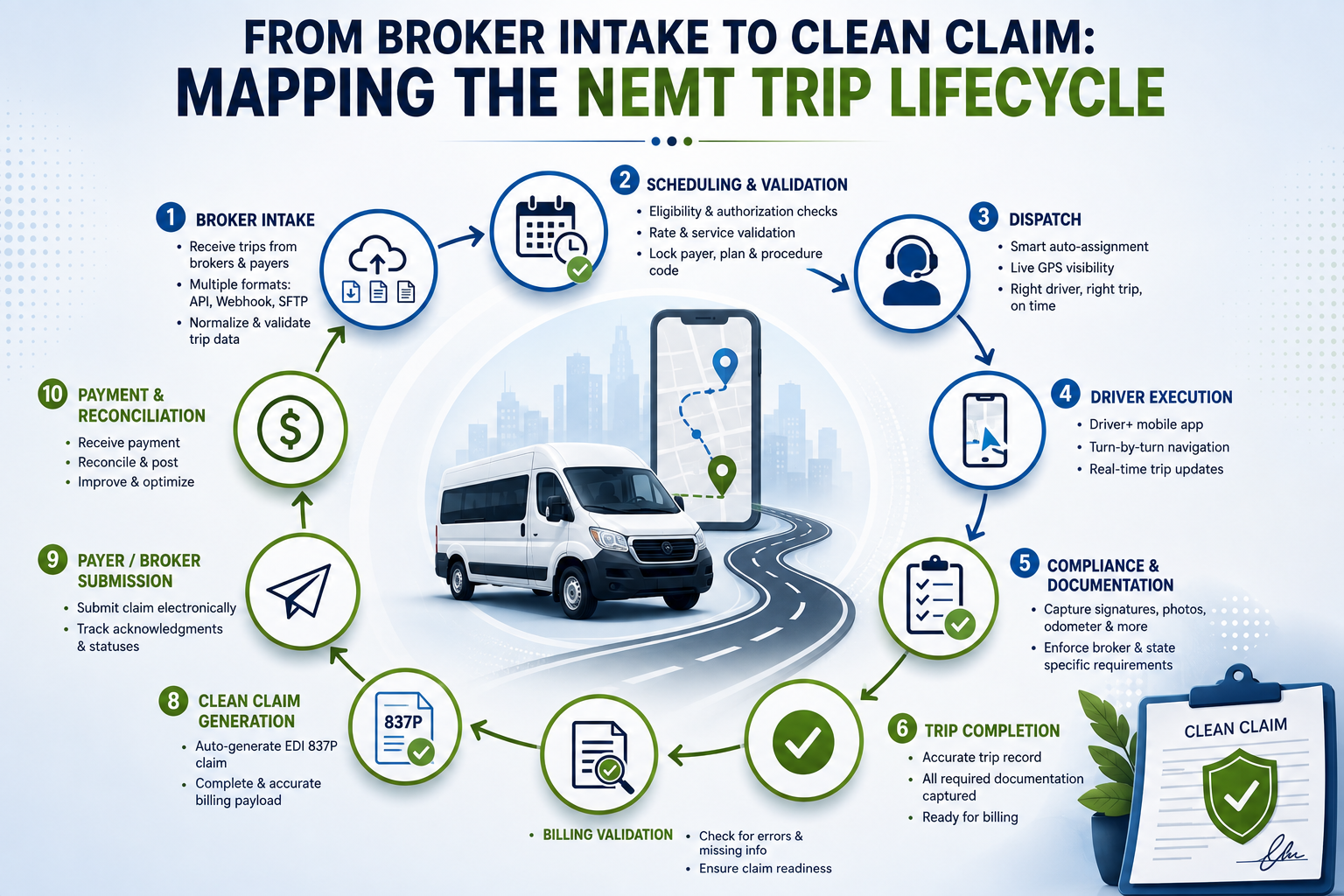
For an NEMT provider, a trip does not begin when a driver starts the engine.
And it certainly does not end when the passenger reaches the destination.
The real lifecycle of an NEMT trip starts when a broker, payer, facility, or other source sends the trip request—and continues through scheduling, eligibility and authorization checks, dispatch, driver execution, documentation, billing, claim submission, and ultimately reimbursement.
That means there are many opportunities for a trip to go wrong.
A trip can be imported incorrectly.
A duplicate roster can create duplicate rides.
An authorization can be missed.
A driver can forget required documentation.
A billing plan can be selected incorrectly.
A claim can contain inconsistent information.
The transportation itself may be completed successfully, yet the provider can still experience a delayed or denied payment.
This is why modern NEMT operations need to think beyond dispatch management.
The objective is to manage the entire trip lifecycle.
Avenex is built around this approach: connecting broker intake, scheduling, dispatch, driver execution, compliance, billing, and claim generation into one workflow. Its own positioning describes the goal as moving a trip from broker intake all the way to a clean claim without gaps between systems.
Why the NEMT Trip Lifecycle Matters
Medicaid transportation programs can use different delivery models, including direct state administration, broker models, and managed-care arrangements. States can also use more than one model for different populations. (Medicaid)
That means NEMT providers often operate in an environment where the same basic transportation service can move through very different operational and billing processes.
A broker may send a trip through an API.
Another may use a webhook.
Another may send a CSV roster.
The provider still has to turn all of those different inputs into a consistent, executable trip.
Then the trip needs to produce the right evidence and billing data.
The lifecycle therefore looks something like:
Broker / Payer
↓
Trip Intake
↓
Scheduling & Validation
↓
Dispatch
↓
Driver Execution
↓
Compliance & Documentation
↓
Trip Completion
↓
Billing Validation
↓
Clean Claim
↓
Payer / Broker Submission
The important point is that every stage depends on the information created by the previous stage.
A problem introduced at intake can become a billing problem days later.
Stage 1: Broker Intake — Where the Trip Enters the System
The first step is receiving the trip.
This sounds simple, but broker integrations are one of the biggest sources of complexity for NEMT providers.
Different brokers can use different:
- Data formats
- APIs
- Webhooks
- File-transfer methods
- Trip identifiers
- Mobility classifications
- Authorization information
- Update and cancellation processes
Avenex is designed to support three primary intake methods:
- Webhook push
- API pull
- SFTP CSV file drops
The platform then maps the incoming data into a common trip structure.
For example, the normalized information can include:
- Member identity
- Pickup and drop-off addresses
- Mobility type
- Service level
- Appointment time
- Scheduled pickup time
- Direction
- Authorization number
- Will-call status
- Special instructions
- Add, update, cancel, or no-show actions
Why normalization matters
Without normalization, dispatchers may have to understand every broker’s unique data format.
With normalization, the broker can speak its own language while the provider works from one consistent operational model.
Different broker formats. One operational workflow.
Stage 2: Protect the Trip From Being Lost
Receiving the trip isn’t enough.
The system also needs to protect it.
Imagine a broker sends a large roster while the provider’s downstream system is temporarily unavailable.
If the data isn’t safely stored, some trips could disappear.
Avenex’s architecture persists the inbound payload immediately before conversion or downstream delivery. It also uses de-duplication and a retry queue to protect against duplicate rosters and temporary connection failures.
This creates an important principle:
A temporary system failure should not become a permanently lost trip.
The workflow becomes:
Receive → Persist → Normalize → Deliver
rather than simply:
Receive → Process → Hope nothing fails
For a provider handling hundreds or thousands of trips, that distinction matters.
Stage 3: Scheduling — Turning Data Into a Valid Trip
Once a trip enters the system, it needs to become a properly scheduled ride.
This is where operational information begins connecting with revenue information.
The coordinator may need to validate:
- Member eligibility
- Authorization
- Available units
- Service level
- Trip type
- Rate information
- Pickup and drop-off details
- Applicable payer plan
Avenex’s scheduling workflow performs live eligibility, authorization-unit, and rate checks. It also supports one-way, round-trip, multi-leg, recurring, will-call, hospital-discharge, and after-hours trips.
But there is another important decision at this stage:
Who is going to be billed?
For members with multiple coverage options, that decision should not be left until the billing department.
Avenex explicitly handles dual-eligibility by requiring the applicable plan to be selected during scheduling and then locking that billing decision to the trip.
This is an important revenue-cycle principle:
Make the billing decision when the trip is created—not after the trip is completed.
Stage 4: Dispatch — Getting the Right Driver to the Right Trip
Once the trip is validated and scheduled, it moves into dispatch.
This is where the provider’s operational efficiency becomes critical.
The dispatcher needs to know:
- Which drivers are available
- Where they are located
- Which vehicles are available
- Which drivers have the required certifications
- Which driver is appropriate for the member’s mobility needs
- Which trips are active
- Which trips require attention
Avenex provides a live GPS map and smart auto-assignment capabilities that can rank drivers based on factors such as certification, proximity, and member preference.
The assigned driver receives the trip through the Driver+ application, while dispatch can monitor trip status through the live trips board.
This creates a continuous operational connection:
Schedule → Assign → Track → Complete
Instead of relying on separate calls, spreadsheets, or manual status updates.
Stage 5: Driver Execution — Where Compliance Becomes Real
The driver is where the digital trip becomes a real-world transportation service.
But this is also where many revenue problems begin.
A driver may successfully complete the transportation but forget one piece of required documentation.
For example:
- Odometer reading
- Member signature
- Delivery photo
- Authorization information
- Required attestation
CMS emphasizes that documentation of transportation services is important both for billing and for audits, and that records should be accurate and complete. (Medicaid)
That means documentation isn’t simply administrative paperwork.
It is part of the evidence supporting the service.
Stage 6: Broker-Specific Requirements Are Enforced During the Trip
One of the biggest challenges for NEMT providers is that requirements can vary by broker.
Avenex’s broker configurations illustrate this clearly.
For example:
MTM
Avenex’s configuration requires odometer start and end readings at delivery, with the MTM authorization number displayed to the driver.
ModivCare
The configured workflow requires a delivery photo before trip completion.
Southeastrans
The configured workflow requires odometer start and end readings at delivery.
The important concept isn’t the individual requirement.
It is where the requirement is enforced.
Instead of expecting drivers to remember a different checklist for every broker, Avenex places broker-specific requirements directly into the driver workflow.
Its Driver+ workflow prevents completion until required documentation is captured.
That changes compliance from:
“Did the driver remember?”
to:
“Did the system enforce the requirement?”
Stage 7: Trip Completion — Creating the Evidence
At the end of the ride, the system needs to establish that the trip actually happened and capture the information required for the next stage.
Avenex captures items such as:
- Actual pickup and drop-off times
- Loaded miles
- GPS information
- Member signature
- Required broker documentation
- Driver information
- Vehicle information
- Authorization details
The platform’s trip workflow also maintains a record of the trip lifecycle rather than treating delivery as an isolated event.
This is important because billing needs more than a simple status saying:
“Trip completed.”
It needs the underlying information required to determine whether the trip is billable and how it should be represented on the claim.
Stage 8: Billing — Where Operations Become Revenue
This is the stage where many NEMT platforms stop.
The trip is completed.
The dispatcher sees it as done.
The transportation company then exports data and sends it to a billing team or another system.
That creates a gap.
Avenex takes a different approach.
Its billing decision is made and locked during scheduling.
The platform snapshots:
- Payer plan
- Procedure code
- EDI payer ID
- Provider NPI
Those values remain associated with the trip rather than being recomputed later.
Why is that important?
Because the information used to bill a trip should be based on the validated decision made for that trip—not reconstructed from memory or spreadsheets after delivery.
Stage 9: Claim Readiness — Catch Problems Before Submission
A completed trip is not automatically a clean claim.
Before submission, the provider needs confidence that the necessary information is present and consistent.
Avenex’s billing workflow includes claim-readiness checks and a canonical billing payload containing information such as:
- Payer and plan
- EDI payer ID
- Procedure code
- Provider NPI
- Driver
- Vehicle
- Member information
- Appointment time
- Actual pickup/drop-off times
- Loaded miles
- Authorization number
- Service level
- Billable status and reason when not billable
This creates a much stronger relationship between the trip record and the claim.
Stage 10: Clean Claim Generation
Once the trip has passed the necessary checks, it can move into claim generation.
Avenex’s documented workflow automatically creates an EDI 837P claim record when the driver marks the trip delivered and the required broker documentation has been satisfied.
The 837P is a standard electronic format used for professional and supplier claims in healthcare transactions. CMS notes that the X12 837P is the electronic professional claim format used under HIPAA transaction standards. (CMS)
The important point for NEMT operators is not simply the format.
It is the continuity of the data.
The information captured at:
Intake
should remain connected to:
Scheduling
which remains connected to:
Dispatch
which remains connected to:
Driver execution
which remains connected to:
Billing
which ultimately produces:
The claim
What Happens When These Stages Are Disconnected?
Let’s look at the traditional fragmented workflow.
Broker sends trip
↓
Dispatcher manually enters it.
Trip gets scheduled
↓
Billing information is stored somewhere else.
Driver completes ride
↓
Paper or mobile documentation is collected.
Billing team receives completed trips
↓
Staff manually checks documentation.
Billing team identifies missing information
↓
Dispatcher contacts driver.
Billing team reconstructs billing information
↓
Claim is created.
Claim is submitted
↓
Payer identifies an issue.
↓
Rework begins.
The transportation happened.
But the revenue lifecycle was fragmented.
The Connected NEMT Lifecycle
Now compare that with a connected model:
1. Broker Intake
Trip received and normalized.
↓
2. Scheduling
Eligibility, authorization, rate, and billing plan validated.
↓
3. Dispatch
Driver assigned based on operational requirements.
↓
4. Driver Execution
Trip completed with required documentation.
↓
5. Compliance
Broker and payer requirements enforced.
↓
6. Billing
Validated trip data flows into billing.
↓
7. Claim Readiness
Potential problems identified before submission.
↓
8. EDI 837P
Clean claim generated.
This is more than software integration.
It is a revenue-protection workflow.
Where Revenue Leakage Usually Begins
Revenue leakage rarely starts at the claim submission screen.
It often begins much earlier.
At Intake
A trip is duplicated or imported incorrectly.
At Scheduling
The wrong payer or plan is selected.
At Dispatch
The wrong driver or vehicle is assigned.
During Execution
Required documentation is missed.
At Completion
The trip lacks sufficient evidence.
At Billing
Information is manually reconstructed.
At Submission
The claim contains a mismatch.
By the time the denial appears, the original mistake may be several stages behind the billing team.
That is why fixing denials one by one isn’t enough.
Providers need to identify where the error entered the lifecycle.
The Role of AI in the NEMT Trip Lifecycle
Automation handles predictable workflow steps.
AI can add another layer by identifying patterns and potential problems.
Avenex’s product positioning includes AI capabilities across the trip lifecycle, including:
- No-show risk scoring
- Authorization assistance
- Route optimization
- ETA prediction
- Auto-assignment ranking
- Claim-denial prediction
Its sales playbook also describes a revenue-protection layer that can analyze trip data, GPS information, documentation, and payer rules before a claim is submitted.
The broader idea is simple:
Don’t wait for the payer to tell you something is wrong.
Identify the risk while the trip is still inside your workflow.
How Avenex Maps the Complete NEMT Trip Lifecycle
Avenex is designed around the complete journey:
01 — Broker Intake
Connect different brokers and formats through API, webhook, and SFTP integrations, normalize trip information, de-duplicate incoming data, and protect against failed deliveries.
02 — Scheduling
Validate eligibility, authorization, rates, and trip details while establishing the billing decision for the trip.
03 — Dispatch
Use live GPS visibility and intelligent driver assignment to move the right driver toward the right trip.
04 — Driver+
Give drivers a mobile workflow for navigation, trip execution, signatures, DVIR, and broker-specific documentation.
05 — Rules & Compliance
Apply state, payer, and broker requirements through configurable rules across the platform. Avenex’s website content specifies coverage for all 50 states plus DC.
06 — Billing
Lock the payer, plan, procedure code, EDI payer ID, and provider information at scheduling rather than reconstructing them later.
07 — Claim Generation
When the trip is delivered and required documentation is complete, Avenex creates the EDI 837P claim record and exposes the canonical billing payload.
The Strongest Advantage: Avenex Doesn’t Stop at Dispatch
This is where Avenex’s positioning becomes different.
A traditional dispatch platform may focus on:
Where is the vehicle?
Avenex extends the question to:
Did the trip happen correctly?
And then:
Do we have the evidence?
And then:
Is the trip billable?
And finally:
Can we turn the completed trip into a clean claim?
That is the difference between a dispatch-first platform and a trip-to-revenue platform.
Avenex’s sales positioning explicitly describes this as being “money-first, not dispatch-first”—following the trip beyond routing and toward payment.
Final Thoughts
Every NEMT trip has two journeys.
The first is the transportation journey:
Broker → Schedule → Dispatch → Driver → Pickup → Drop-off
The second is the revenue journey:
Trip Data → Documentation → Validation → Billing → Claim → Payment
The problem is that many NEMT operations manage these as two separate processes.
That’s where gaps appear.
A missing signature becomes a billing problem.
A wrong payer becomes a claim problem.
A broker update becomes a scheduling problem.
A documentation gap becomes an audit problem.
A disconnected billing workflow becomes a revenue problem.
The strongest NEMT technology connects these journeys into one.
A trip should not simply end when the passenger reaches the destination.
It should continue through documentation, validation, billing, and claim submission until the provider has a clear path to reimbursement.
Avenex: From Broker Intake to Clean Claim
Avenex brings the entire NEMT lifecycle into one connected platform:
Broker Integration → Scheduling → Dispatch → Driver+ → Compliance → Billing → EDI 837P
It handles multiple broker intake methods, normalizes trip data, protects against duplicate or lost imports, validates trips during scheduling, provides live dispatch visibility, enforces broker-specific driver requirements, applies configurable state and payer rules, and automatically carries validated billing information into claim generation.
But the strongest point is bigger than any individual feature:
Avenex doesn’t just help providers manage trips. It connects the trip to the revenue it is supposed to generate.
Every trip. Every broker. One platform. From broker intake to clean claim.