
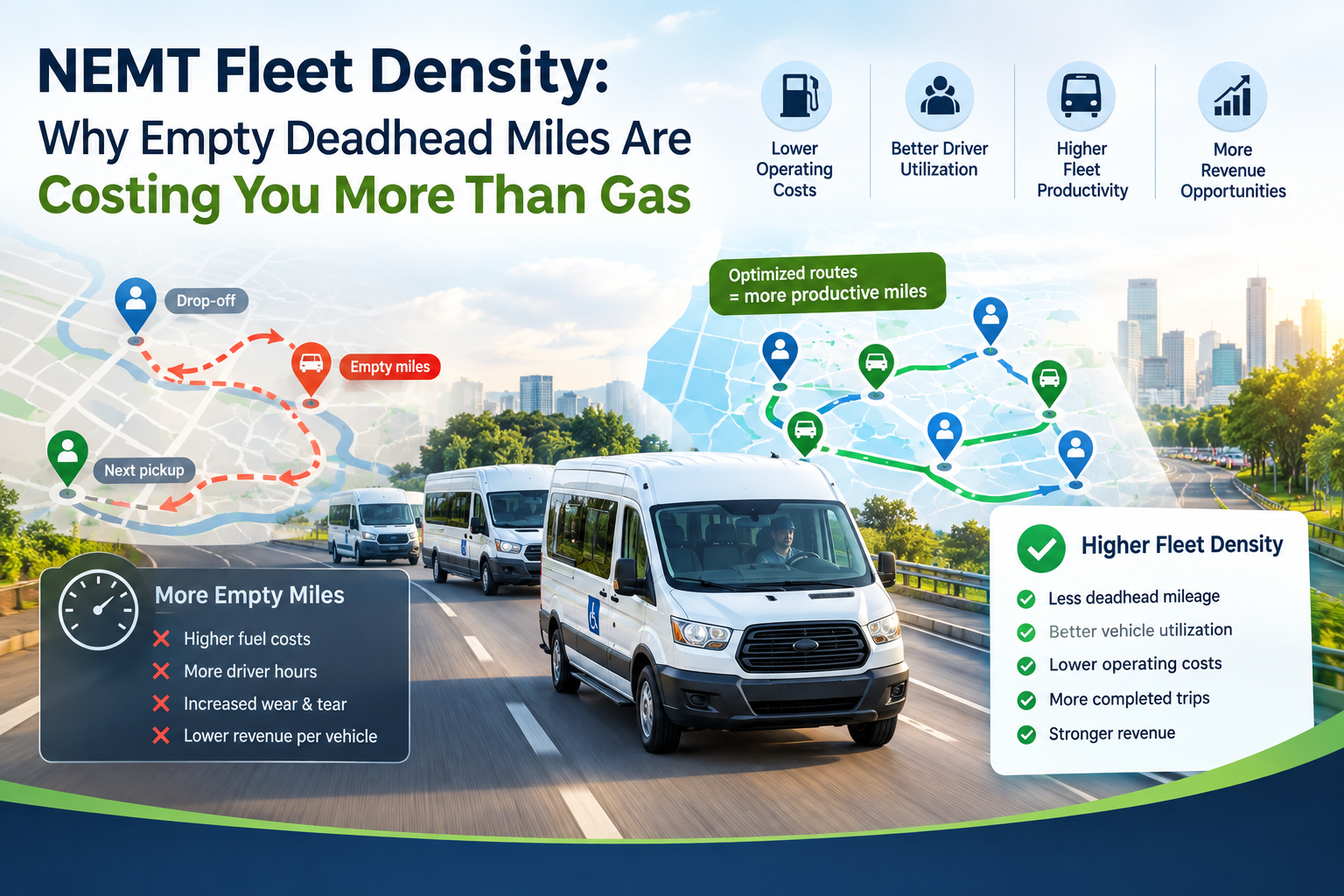
For an NEMT provider, an empty vehicle is rarely just an empty vehicle.
It is a driver being paid without a passenger onboard.
It is vehicle depreciation without revenue attached to the miles.
It is maintenance consumed without producing a billable trip.
It is time that could have been used for another passenger.
And, in many Medicaid transportation arrangements, those empty miles may not be directly reimbursable.
This is the hidden economics of deadhead mileage.
A vehicle drives from the depot to pick up a passenger.
Then it drives back empty.
Or a driver completes a trip on one side of the service area and travels a significant distance to another pickup.
The odometer keeps moving.
But revenue may not.
The Federal Transit Administration’s NEMT cost-allocation research notes that many Medicaid programs pay for loaded miles rather than deadhead miles, while providers still incur the operating costs associated with those empty miles.
That creates a fundamental NEMT business challenge:
The goal isn’t simply to keep every vehicle moving. The goal is to keep vehicles moving productively.
And that is where fleet density becomes important.
What Is NEMT Fleet Density?
Fleet density is essentially about how efficiently a provider concentrates productive trips within its available fleet, drivers, and service area.
A simple way to think about it is:
More productive trips + less empty travel = higher fleet utilization
A fleet can be extremely busy and still be inefficient.
Imagine two vehicles each operating for eight hours.
Fleet A
- 8 hours operating
- 7 passenger trips
- 180 loaded miles
- 40 deadhead miles
Fleet B
- 8 hours operating
- 5 passenger trips
- 130 loaded miles
- 110 deadhead miles
Both vehicles were working.
But Fleet B consumed significantly more time and distance without passengers.
That difference doesn’t necessarily show up as an obvious “fuel problem.”
It shows up across the entire cost structure.
Deadhead Miles Are More Than Fuel
When NEMT operators talk about empty miles, the conversation often starts with fuel.
Fuel matters.
But it is only one part of the cost.
Every additional empty mile can contribute to:
- Fuel consumption
- Tire wear
- Oil and maintenance
- Vehicle depreciation
- Driver labor
- Overtime exposure
- Vehicle availability
- Scheduling inefficiency
- Lower trip capacity
- Reduced revenue per vehicle hour
Consider a simple example.
A vehicle travels:
25 miles to a passenger
then completes:
20 loaded miles
and afterward travels:
25 miles empty to its next assignment.
The passenger generated 20 loaded miles, but the vehicle traveled 70 total miles.
That means only a portion of the vehicle’s movement was directly associated with transporting a passenger.
The real question for the operator becomes:
How much productive transportation can we generate from every vehicle hour and vehicle mile?
The Hidden Cost: Driver Time
Fuel is measurable.
Driver time is often more expensive.
Suppose a driver spends 30 minutes traveling empty between assignments.
That isn’t just 30 minutes of fuel consumption.
It is 30 minutes of:
- Paid labor
- Vehicle availability
- Insurance exposure
- Maintenance utilization
- Lost trip capacity
And if that happens repeatedly throughout the day, the provider may lose the opportunity to schedule additional trips.
This creates a compounding effect.
One empty trip
Creates:
Fuel + labor + vehicle cost
Repeated empty trips
Create:
Fuel + labor + vehicle cost + lost capacity
That last component is often the hardest to see.
The Opportunity Cost of an Empty Vehicle
Imagine a provider has 20 vehicles.
Each vehicle has a limited number of productive hours per day.
If a vehicle spends too much time:
- Driving empty
- Waiting for assignments
- Returning to a depot
- Traveling long distances between unrelated trips
then the provider has fewer productive hours available for revenue-generating transportation.
The problem isn’t necessarily that the fleet is too small.
Sometimes the fleet is poorly utilized.
This is why adding more vehicles isn’t always the best solution to growing demand.
Before adding capacity, operators should ask:
Are we getting enough productive utilization from the capacity we already have?
What Causes Excessive Deadhead Miles?
Deadhead mileage rarely has a single cause.
It is usually the result of several operational decisions.
1. Assigning the Wrong Vehicle
A trip may be assigned to a driver who is available but far away.
The vehicle gets the job done—but creates unnecessary empty mileage.
2. Dispatching Based Only on Availability
A driver being “available” doesn’t necessarily mean the driver is the best choice.
A better assignment considers:
- Current location
- Distance to pickup
- Vehicle capability
- Driver certification
- Schedule availability
- Existing route
- Passenger requirements
- Next likely assignment
Avenex’s Smart Dispatch approach uses factors including driver credentials, vehicle capabilities, proximity, and schedule availability when ranking assignments.
3. Treating Every Trip as an Independent Assignment
This is one of the biggest opportunities for improvement.
Consider:
Trip A: 10:00 AM pickup in City A
Trip B: 11:15 AM pickup 5 miles away
A dispatcher looking at each trip independently may assign two different vehicles.
A dispatcher looking at the fleet as a network may recognize that the vehicle completing Trip A can potentially serve Trip B.
That is fleet density thinking.
4. Poor Geographic Clustering
NEMT trips are often spread across a service area.
If a provider doesn’t consider geography when building schedules, vehicles can spend large portions of the day crossing the same territory repeatedly.
For example:
Vehicle 1: North → South → North
Vehicle 2: South → North → South
Both vehicles may technically be busy.
But the fleet is moving inefficiently.
Better geographic clustering can reduce unnecessary cross-town movement.
5. Gaps Between Scheduled Trips
A vehicle completes a trip at 11:00 AM.
The next trip begins at 1:00 PM.
The vehicle may sit idle for two hours—or travel back to a depot and later travel out again.
The issue isn’t always a lack of demand.
It can be a lack of trip density within the driver’s schedule.
The more effectively providers can group compatible trips geographically and temporally, the more productive each vehicle hour can become.
6. No Real-Time Visibility
A static dispatch board tells you what was planned.
A live dispatch system tells you what is happening.
That difference matters.
A driver may be:
- Delayed
- Already nearby
- Completing a trip early
- Stuck in traffic
- Waiting at a facility
- Available earlier than expected
If dispatchers don’t see those changes in real time, the next assignment may be based on outdated information.
That can create avoidable empty travel.
Fleet Density Is a Dispatch Problem—and a Revenue Problem
Deadhead miles begin in operations.
But their impact reaches the financial side of the business.
Consider the chain:
Poor assignment
↓
More empty miles
↓
More driver hours
↓
Higher operating cost
↓
Fewer productive trip opportunities
↓
Lower revenue per vehicle
This is why fleet optimization shouldn’t be measured only by:
“How many trips did we complete?”
A better question is:
“How efficiently did we use the fleet to complete those trips?”
The Metrics NEMT Operators Should Watch
If an NEMT provider wants to improve fleet density, it needs visibility into more than trip counts.
1. Deadhead Miles
How many miles are vehicles traveling without a passenger?
Track:
Total deadhead miles / total vehicle miles
This provides a clearer picture of empty movement.
2. Loaded Miles
How many miles are spent transporting passengers?
The relationship between loaded and total mileage helps operators understand vehicle productivity.
3. Deadhead-to-Loaded Ratio
This can provide an easy operational signal.
For example:
50 deadhead miles / 200 loaded miles = 25%
A rising ratio may indicate deteriorating dispatch efficiency, geographic imbalance, or poor trip clustering.
4. Revenue per Vehicle Hour
A vehicle that produces more revenue during the same number of operating hours is generally being utilized more effectively.
5. Trips per Vehicle per Day
This provides another way to understand fleet productivity.
But it should not be viewed alone.
A vehicle completing many short trips may have a very different utilization profile from one completing fewer long-distance trips.
6. Empty Time Between Trips
Mileage isn’t the only problem.
Track how much time vehicles spend:
- Waiting
- Returning
- Repositioning
- Traveling to their next assignment
7. On-Time Performance
Optimization shouldn’t come at the expense of service quality.
A good dispatch strategy needs to balance:
Efficiency + On-time performance + Compliance + Passenger needs
The Goal Isn’t Zero Deadhead Miles
This is an important distinction.
Zero deadhead miles is unrealistic.
NEMT providers need to position vehicles.
Drivers have to travel to pickup locations.
Rural trips can create significant geographic gaps.
Certain mobility requirements may limit which vehicles can be assigned.
Some trips simply cannot be chained efficiently.
The objective is therefore not:
“Eliminate every empty mile.”
The objective is:
“Eliminate avoidable empty miles.”
That’s a much more practical goal.
Rural NEMT Makes Fleet Density Even More Challenging
Urban and rural NEMT operations have very different density patterns.
In an urban market, a vehicle may complete multiple trips within a relatively small geographic area.
In a rural market, a single trip can require substantial travel before and after the passenger portion of the journey.
That makes dispatch optimization particularly important.
Providers need to understand:
- Where demand is concentrated
- Where drivers are positioned
- Which trips can be grouped
- Which vehicles can serve specific mobility needs
- How return journeys can be utilized
- Where empty repositioning is unavoidable
A fleet strategy that works in a dense urban market may not work in a rural service area.
Multi-Trip Scheduling Can Change Fleet Economics
Suppose a vehicle has the following assignments:
Trip 1: 8:00 AM — Pickup A → Medical Center
Trip 2: 10:00 AM — Medical Center → Pickup B
Trip 3: 11:30 AM — Pickup B → Clinic C
Trip 4: 1:30 PM — Clinic C → Member D
If these trips can be logically connected, the vehicle stays within a productive service pattern.
Compare that with:
Trip 1 → Depot → Trip 2 → Depot → Trip 3 → Depot
The second model may generate significantly more empty movement.
The difference is not necessarily the number of trips.
It is the relationship between trips.
AI Can Help Dispatchers Think Beyond the Next Trip
Traditional dispatch often asks:
“Which driver is available?”
Smarter dispatch asks:
“Which driver is the best asset for this trip, considering what is happening now and what happens next?”
That’s a much more sophisticated question.
AI-assisted dispatch can consider multiple factors simultaneously:
- Driver location
- Vehicle capability
- Certification
- Current trip status
- Schedule availability
- Geographic proximity
- Traffic
- Pickup timing
- Future assignments
Avenex describes its Smart Dispatch engine as using proximity, vehicle capabilities, credentials, schedule availability, and dynamic traffic patterns to optimize assignment and reduce excessive deadhead mileage.
This is where technology can turn a dispatch board into a fleet optimization system.
From “Available Driver” to “Best Available Asset”
This is a subtle but important change.
Traditional dispatch:
Available driver → Assign trip
Optimized dispatch:
Trip requirements → Evaluate fleet → Rank suitable assets → Assign best option → Monitor → Re-optimize
The second approach considers the fleet as a connected system.
And that’s important because every assignment affects the next assignment.
What Happens When Dispatch and Fleet Data Are Connected?
Imagine the system knows:
Driver A
- 3 miles from pickup
- Wheelchair certified
- Vehicle has lift
- Available in 10 minutes
Driver B
- 15 miles from pickup
- Wheelchair certified
- Similar vehicle
- Available now
A simple availability-based system may select Driver B.
A proximity-aware system can recognize that Driver A is the more efficient assignment.
Now multiply that decision across:
50 vehicles × 20 trips × 5 days
Small improvements in individual assignments can become meaningful operational savings.
The Business Case for Reducing Deadhead Miles
Reducing unnecessary empty mileage can produce benefits beyond fuel savings.
Lower Operating Costs
Fewer empty miles can reduce fuel and maintenance consumption.
Better Driver Utilization
Less time spent repositioning means more time available for productive trips.
Higher Fleet Productivity
The same fleet can potentially serve more demand without immediately adding vehicles.
Better Scheduling
Trips can be organized around geographic and temporal relationships.
Improved Service
Better positioning can help reduce pickup delays.
Stronger Revenue Potential
More productive vehicle hours can create more opportunities to complete reimbursable trips.
This is why fleet density belongs in the conversation about revenue optimization, not just fleet management.
Avenex: Turning Fleet Density Into a Revenue Advantage
This is where Avenex takes the concept beyond basic GPS tracking.
Avenex’s Smart Dispatch platform is designed to give dispatch teams a centralized live view of fleet activity and use intelligent assignment to match trips with appropriate vehicles and drivers. Its stated capabilities include real-time fleet control, proximity-based assignment, vehicle capability matching, credential checks, and route optimization.
The important distinction is:
GPS tells you where your vehicles are.
Smart dispatch helps determine where they should go next.
That difference can directly influence fleet density.
Avenex Helps Reduce the Hidden Cost of Empty Miles
Avenex’s dispatch approach addresses excessive deadhead mileage by ranking active, certified drivers based on factors such as:
- Exact proximity
- Vehicle lift/capability
- Schedule availability
- Driver credentials
- Traffic conditions
The goal is to prevent dispatchers from assigning a trip simply because a driver appears available when another qualified vehicle is better positioned.
And because Avenex connects dispatch with the broader NEMT lifecycle, fleet optimization doesn’t exist in isolation.
The same platform can connect:
Broker Integration
→ Scheduling
→ Dispatch
→ Driver+
→ Compliance
→ Billing
→ Revenue Recovery
That matters because the best fleet assignment is not simply the shortest route.
It must also be the right driver, right vehicle, right trip, and right compliance profile.