
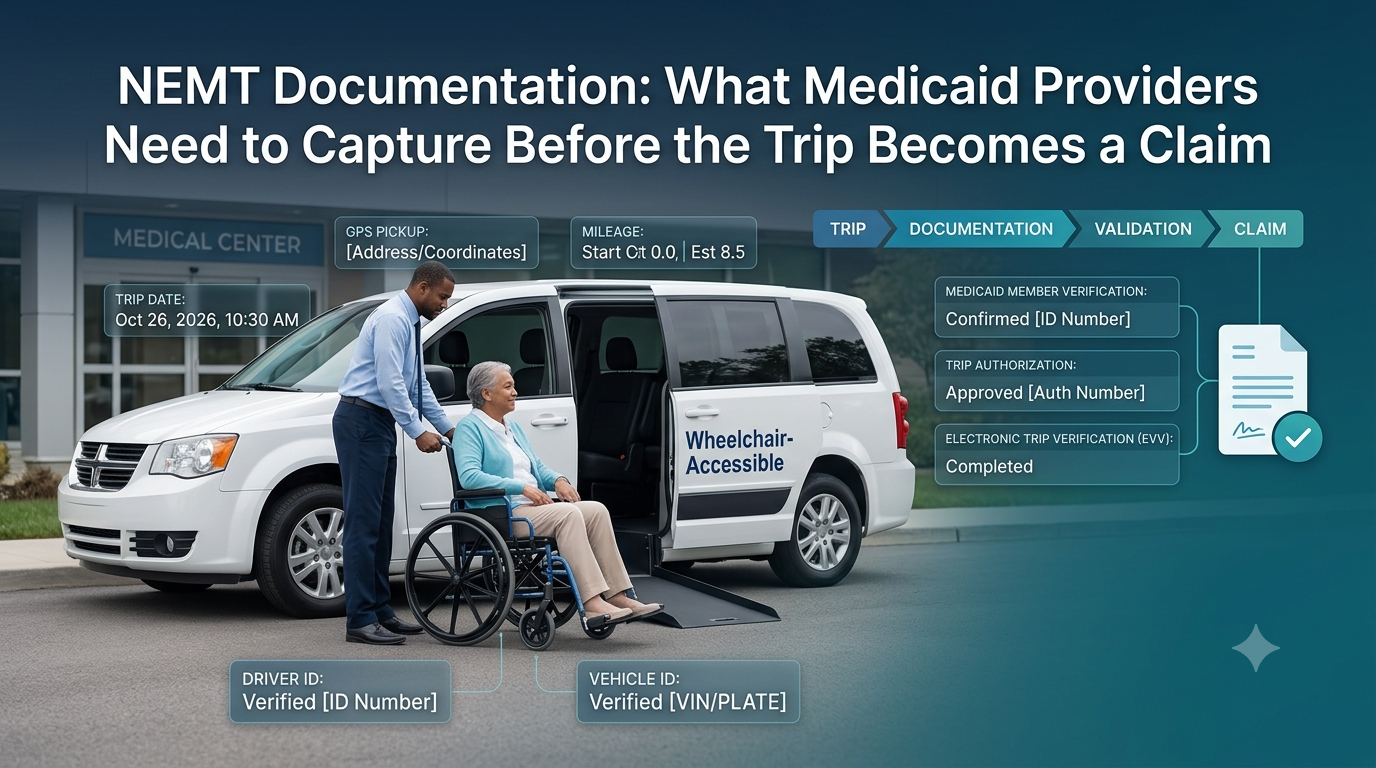
For Medicaid NEMT providers, a completed trip is not automatically a billable trip.
Before a ride becomes a claim, there needs to be a reliable record showing who traveled, where they traveled, why the trip was eligible, when the service occurred, and what transportation service was actually provided.
That documentation is more than paperwork. It is the evidence behind the claim.
CMS guidance emphasizes that NEMT records should be accurate and complete enough to demonstrate that the transportation was necessary and furnished to a Medicaid beneficiary for access to covered services. Documentation also plays an important role when claims are reviewed or audited.
For NEMT providers working with Medicaid programs and transportation brokers, the challenge is making sure the right information is captured during the trip—not reconstructed after billing begins.
Why NEMT Documentation Matters
Medicaid transportation programs operate under federal requirements, but individual states and transportation arrangements can have additional rules.
That means the documentation required for one NEMT program may not be identical to another.
At the federal level, CMS identifies several core elements that transportation providers should capture. CMS’s NEMT provider guidance notes that, at a minimum, states require documentation of the beneficiary’s name and Medicaid identifier, pickup and drop-off locations, date and time of service, and miles traveled with the beneficiary in the vehicle.
But the real operational question for providers is:
Can your trip record tell the complete story of the ride?
If not, the problem may appear later as a rejected claim, payment delay, documentation request, or audit issue.
1. Beneficiary Information
Every trip should be connected to the correct Medicaid member.
The trip record should capture information such as:
- Beneficiary name
- Medicaid identification number
- Trip or reservation ID
- Eligibility information, where required
- Broker or payer reference
- Authorization or approval information, when applicable
The Medicaid ID is especially important because the transportation record must ultimately connect the trip to the correct beneficiary and payer.
A simple data-entry error can create a much bigger billing problem later.
Wrong member → wrong trip record → wrong claim.
That is why beneficiary information should be validated before the trip is dispatched whenever possible.
2. Pickup and Drop-Off Locations
The trip record should clearly establish where the transportation started and where it ended.
Capture:
Pickup
- Address or approved location
- Pickup time
- Actual pickup time, where required
Drop-off
- Destination
- Drop-off time
- Actual arrival time, where required
For Medicaid transportation, the destination also matters because NEMT exists to help beneficiaries access covered medical services.
A trip record that simply says “medical appointment” may not provide enough operational detail.
The system should preserve the actual trip information needed to connect the ride to the scheduled service.
3. Date, Time and Trip Status
A scheduled ride and a completed ride are not the same thing.
Your documentation should distinguish between:
- Scheduled time
- Actual pickup time
- Actual drop-off time
- No-show
- Cancellation
- Driver cancellation
- Completed trip
- Partial trip
- Returned trip, when applicable
This distinction becomes extremely important when the trip reaches billing.
For example:
Scheduled: 9:00 AM
Driver arrived: 8:52 AM
Passenger boarded: 9:04 AM
Drop-off: 9:31 AM
That information creates a much stronger operational record than simply storing “Trip completed.”
4. Loaded Miles — Not Just Vehicle Miles
Mileage is one of the most important pieces of NEMT documentation.
CMS provider guidance specifically distinguishes the miles traveled with the beneficiary in the vehicle from other vehicle mileage.
That means providers should avoid treating every mile driven by a vehicle as billable passenger mileage.
A trip record may need to distinguish between:
- Loaded miles
- Deadhead miles
- Total vehicle miles
- Pickup-to-drop-off mileage
For billing purposes, the applicable Medicaid or broker rules should determine which mileage is used.
This is also where automated mileage capture can reduce manual errors.
5. Driver and Vehicle Information
The trip record should be connected to the driver and vehicle that actually performed the service.
Depending on the state, broker, or transportation program, this may include:
- Driver ID
- Driver name
- Vehicle ID
- Vehicle type
- License information
- Trip assignment
- Compliance status
CMS also highlights minimum requirements involving NEMT providers and drivers, including valid driver licenses, exclusion screening, processes related to state drug-law violations, and disclosure of driving history.
This means compliance information should not live separately from transportation operations.
A provider needs to know:
Was the driver eligible to perform this trip when the trip occurred?
6. Transportation Level and Service Details
Not every Medicaid member requires the same type of transportation.
Depending on the program and authorization, a trip may involve:
- Ambulatory transportation
- Wheelchair transportation
- Stretcher transportation
- Accessible vehicle requirements
- Escort requirements
- Mileage reimbursement
- Other approved transportation arrangements
The trip record should capture the transportation service that was actually provided.
This helps prevent a common billing problem:
The scheduled service and the delivered service do not match.
If the system captures service type at dispatch and carries it through to billing, discrepancies can be identified before the claim is submitted.
7. Broker, Authorization and Trip Reference Data
Many Medicaid NEMT providers operate through brokers, managed care organizations, or other transportation arrangements.
That creates another important documentation layer.
The provider may need to retain:
- Trip authorization number
- Broker trip ID
- Member reference
- Scheduled service type
- Authorized mileage
- Pickup/drop-off details
- Broker instructions
- Changes to the original trip
The exact requirements vary by state and program, so providers should always follow their applicable Medicaid and broker requirements.
But operationally, one principle remains consistent:
The trip your dispatch system records should be traceable to the trip the broker authorized.
8. Proof That the Trip Actually Happened
A claim represents a service that was provided.
Therefore, providers need evidence supporting the completed trip.
Depending on state or broker requirements, this may include:
- Beneficiary signature
- Driver attestation
- Electronic trip confirmation
- GPS or location information
- Pickup/drop-off timestamps
- Electronic trip logs
- Broker confirmation
- Other approved verification methods
CMS notes that some states and brokers require beneficiary signatures, while also emphasizing that management or a designated person remains responsible for verifying that documented services were actually furnished.
The goal is not simply collecting a signature.
The goal is creating a verifiable record of service delivery.
The Bigger Problem: Documentation Is Often Disconnected
For many NEMT providers, the information needed for billing exists—but in different places.
Dispatch has one record.
The driver has another.
The broker has another.
Mileage may be captured separately.
Compliance information may live in a spreadsheet.
Billing then has to bring everything together.
That creates opportunities for:
- Missing trip information
- Incorrect Medicaid IDs
- Mileage discrepancies
- Duplicate trips
- Unverified completed rides
- Incorrect service types
- Missing authorization information
- Manual billing errors
The result?
A trip can be successfully completed operationally but still become difficult to bill.
From Trip to Clean Claim
A better approach is to treat documentation as part of the revenue cycle, not as an administrative task after the ride.
The workflow should look something like this:
Trip Request
↓
Eligibility & Authorization Check
↓
Dispatch & Driver Assignment
↓
Trip Execution
↓
Real-Time Documentation
↓
Trip Validation
↓
Billing Validation
↓
Claim Submission
↓
Payment & Reconciliation
The critical step is between Trip Execution and Claim Submission.
This is where the provider can identify missing or inconsistent information before it becomes a billing problem.
What Should Be Validated Before Billing?
Before a completed NEMT trip moves into the billing workflow, providers should ask:
Beneficiary
- Is the correct Medicaid member attached?
- Is the Medicaid ID valid?
- Does the trip match the authorized member?
Trip
- Are pickup and drop-off locations recorded?
- Are actual times captured?
- Is the trip status accurate?
Mileage
- Is the mileage documented correctly?
- Are loaded miles separated from deadhead mileage where required?
Driver & Vehicle
- Is the assigned driver documented?
- Was the driver eligible and compliant?
- Is the correct vehicle associated with the trip?
Authorization
- Is the broker or authorization reference captured?
- Does the delivered service match what was authorized?
Verification
- Is the required trip verification present?
- Are signatures, attestations, or electronic confirmations available where required?
Billing
- Does the trip contain everything required to create the applicable claim?
- Are there inconsistencies that should be resolved before submission?
If the answer to any of these is “no,” the trip should be flagged for review rather than automatically moving to billing.
Why Real-Time Documentation Is Better Than End-of-Day Data Entry
The longer a provider waits to document a trip, the greater the chance that information will be forgotten, entered incorrectly, or disconnected from the original ride.
Imagine a driver completes 20 trips in one day and enters mileage and trip details hours later.
Now consider another workflow where the system captures:
Pickup → Driver → Passenger → Mileage → Drop-off → Verification
as the trip happens.
The second workflow creates a much stronger foundation for billing.
It also gives operations teams better visibility into exceptions before they reach accounts receivable.
Build the Claim From the Trip Record
The best NEMT billing workflow should not start with:
“What information do we need to enter into the claim?”
It should start with:
“Did we capture everything required when the trip happened?”
That shift is important.
The claim should be the output of a validated trip record, not a separate manual process.
When transportation data flows directly from dispatch into billing, providers can reduce duplicate entry, identify missing information earlier, and create a stronger audit trail.
How Avenex Helps Connect Dispatch, Compliance and Revenue
For NEMT providers, documentation becomes much more valuable when it is connected across the entire transportation workflow.
Avenex brings dispatch management, driver and vehicle workflows, compliance, broker connectivity, trip data, and revenue processes into one operational environment.
Instead of treating documentation as paperwork created after a ride, providers can make it part of the trip lifecycle.
The goal is simple:
Capture the right data. Validate it before billing. Turn completed trips into cleaner claims.
Because in Medicaid NEMT, the trip does not end when the passenger reaches the destination.
The trip ends when the service is documented, validated, and ready to support the claim.