Running a successful Non-Emergency Medical Transportation (NEMT) business is about much more than getting patients safely to their appointments. While dispatching vehicles efficiently is essential, it is only one part of the journey.
The real business outcome isn’t completing a trip, it’s getting paid for that trip.
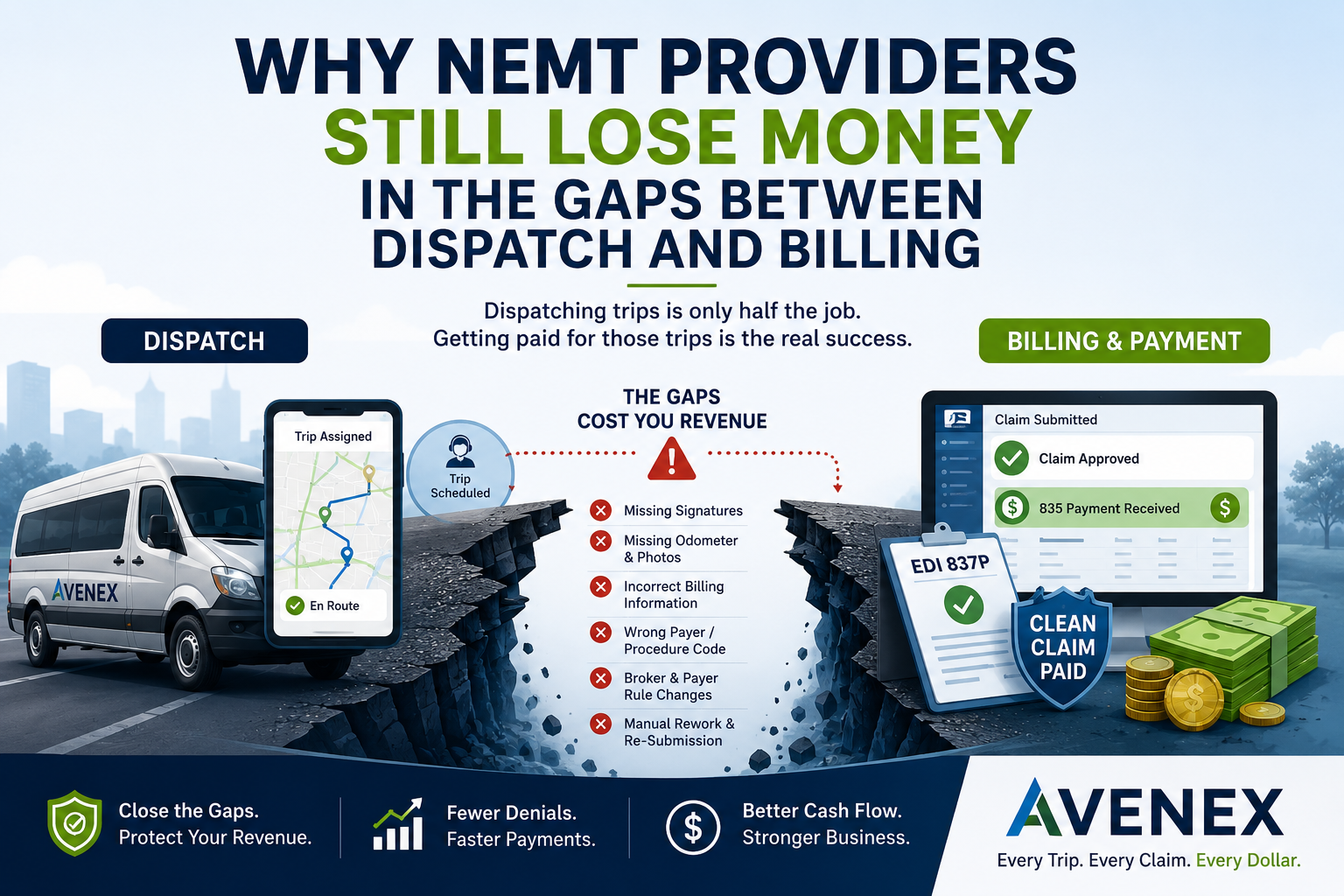
Unfortunately, many NEMT providers continue to lose thousands of dollars each month, not because they aren’t transporting patients, but because critical information is lost between dispatch, drivers, compliance, and billing.
These hidden operational gaps often result in delayed payments, denied claims, unnecessary administrative work, and lost revenue.
In this article, we’ll explore where these gaps occur, why they happen, and how modern NEMT technology helps providers protect revenue from the moment a trip is scheduled until reimbursement is received.
The Hidden Cost of Operational Gaps
Many providers assume that once a driver completes a trip, the difficult part is over.
In reality, that’s often where revenue risks begin.
Every completed trip must include the correct documentation, accurate mileage, valid member information, payer details, required signatures, compliance checks, and billing data before it can become a successful claim.
When even one piece of information is missing, the billing team must manually investigate the issue—or worse, the claim is denied.
While each individual mistake may seem small, these errors accumulate over hundreds or thousands of trips every month.
The result is slower cash flow, increased administrative costs, and lower profitability.
Where Revenue Leaks Actually Happen
Most revenue leakage doesn’t happen because of major system failures.
It happens during everyday operations.
1. Disconnected Systems
Many NEMT providers use separate solutions for:
- Broker integrations
- Scheduling
- Dispatch
- Driver applications
- Billing
- Compliance
Because these systems don’t always communicate effectively, staff often re-enter information manually.
Manual data transfer increases the risk of:
- Duplicate entries
- Missing trip information
- Incorrect member data
- Lost documentation
Each manual touchpoint creates another opportunity for mistakes.
2. Missing Driver Documentation
Driver documentation plays a critical role in successful reimbursement.
Common missing items include:
- Odometer readings
- Member signatures
- Delivery photographs
- GPS verification
- Authorization numbers
When these items are forgotten during trip completion, billing teams often discover the issue days or weeks later.
At that point, recovering the missing documentation may be impossible.
3. Incorrect Billing Decisions
Billing decisions shouldn’t be made after a trip is complete.
Information such as:
- Payer
- Procedure code
- Provider
- Member plan
- Special transportation service (STS) eligibility
should already be determined during scheduling.
When billing staff have to reconstruct these details later, errors become much more likely—especially for dual-eligible members covered by multiple plans.
4. Broker-Specific Requirements
Not every broker follows the same rules.
Some require:
- Odometer readings
- Delivery photos
- Member signatures
- Specific authorization references
- Special documentation
If drivers don’t know which requirements apply to each trip, completed rides can quickly turn into denied claims.
5. Rule Changes
Medicaid regulations, payer requirements, and broker policies continue to evolve.
Many providers still rely on spreadsheets, emails, or staff knowledge to keep track of these changes.
Unfortunately, outdated information often isn’t discovered until claims begin coming back unpaid.
Dispatch Success Doesn’t Guarantee Payment
A common misconception is that operational efficiency automatically leads to financial success.
Imagine this scenario.
A dispatcher schedules 120 trips.
Drivers complete all 120.
Every patient reaches their appointment.
From an operations perspective, it appears to be a perfect day.
However:
- Eight trips are missing signatures.
- Five have incorrect procedure codes.
- Three lack required odometer readings.
- Four are billed to the wrong payer.
- Two include incomplete authorization details.
Although the transportation service was delivered successfully, several claims may now require manual correction—or be denied entirely.
The operational work was successful.
The revenue process was not.
The Cost of Manual Rework
Every denied claim creates additional work.
Billing teams must:
- Review trip records
- Contact dispatch
- Reach out to drivers
- Verify broker requirements
- Correct documentation
- Resubmit claims
- Monitor payment status
Instead of focusing on growth, staff spend valuable time fixing preventable problems.
Over time, this administrative burden increases labour costs while delaying reimbursement.
Closing the Gap with an Integrated NEMT Platform
Modern NEMT providers are moving beyond standalone dispatch systems.
Instead, they’re adopting platforms that connect every stage of the transportation lifecycle.
An integrated solution helps ensure that information flows seamlessly from:
Broker Intake → Scheduling → Dispatch → Driver App → Billing → Claim Submission
Rather than relying on manual coordination between departments, the platform maintains a single, consistent record throughout the trip.
What Revenue Protection Looks Like
Technology can reduce many of the common causes of claim denials by preventing errors before they happen.
Key capabilities include:
Intelligent Trip Intake
Automatically receive trips from multiple brokers without duplicate entries or lost data.
Scheduling Validation
Verify eligibility, authorizations, billing plans, and trip details before dispatch.
Driver Compliance
Require mandatory documentation such as:
- GPS verification
- Signatures
- Odometer readings
- Delivery photos
before a trip can be marked complete.
Automated Billing
Generate claims using billing information captured during scheduling rather than recreating it after delivery.
Configurable Rules
Apply broker, payer, and state-specific requirements automatically without relying on staff memory.
Why Revenue Protection Is Becoming a Competitive Advantage
The NEMT industry continues to evolve.
Providers are expected to:
- Handle more trips.
- Work with multiple brokers.
- Meet stricter compliance standards.
- Reduce claim denials.
- Improve cash flow.
- Operate with lean administrative teams.
Achieving these goals requires more than efficient dispatching.
It requires protecting revenue throughout the entire transportation journey.
Organisations that connect operations and billing are often better positioned to:
- Reduce administrative workload.
- Submit cleaner claims.
- Improve first-pass claim acceptance.
- Accelerate reimbursement.
- Scale without proportionally increasing billing staff.
How Avenex Helps Bridge the Gap
Avenex is designed specifically for Medicaid and Medicare NEMT providers, connecting the full trip lifecycle within a single platform.
From broker intake and scheduling to dispatch, driver workflows, billing, and compliance, every stage is linked to help reduce operational gaps that can lead to claim denials.
Features such as broker-specific delivery requirements, billing snapshots captured during scheduling, automated EDI 837P claim generation, configurable state rules, and integrated compliance workflows help providers move from completed trips to cleaner claims with greater confidence.
Rather than treating dispatch and billing as separate processes, Avenex helps ensure they work together as one connected revenue workflow.
Final Thoughts
The biggest revenue risks in NEMT rarely come from trips that were never completed.
They come from the information lost between departments after the ride is over.
Every missing signature, incorrect procedure code, incomplete document, or billing error creates unnecessary delays and avoidable administrative work.
By connecting dispatch, drivers, compliance, and billing into a single workflow, NEMT providers can reduce these gaps, improve operational visibility, and strengthen financial performance.
Because in today’s NEMT environment, completing the trip is only half the job.
Getting paid accurately and on time is what truly drives sustainable growth.
Ready to Reduce Revenue Leakage?
If you’re looking to simplify operations, reduce claim denials, and improve cash flow, discover how Avenex connects every step of the NEMT journey—from broker intake to clean claim generation.